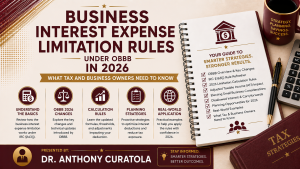
EVENT DESCRIPTION
TCJA capped the business interest deduction and, for 2022–2024, removed depreciation and amortization from adjusted taxable income — shrinking the deduction along with the base. OBBB permanently reverses that beginning in 2025, and for leveraged businesses the swing is substantial.
This two-hour course covers IRC § 163(j) as it applies in 2026: the limitation formula, the ATI computation with the restored add-backs, the floor plan financing component and its bonus depreciation trade-off, the § 448(c) small business exception, excepted trades and businesses, the permanent excess business loss limitation, and Form 8990 reporting. Substantial attention goes to pass-through entities, where partnerships and S corporations diverge sharply on carryforwards and basis. The course closes with the § 199A deduction, including OBBB's permanence, widened phase-out ranges, and the new $400 minimum deduction.
EVENT OBJECTIVE
Upon completion of this course, participants will be able to:
- Calculate the § 163(j) limitation using business interest income, 30% of ATI, and floor plan financing interest.
- Recognize OBBB's permanent restoration of the depreciation, amortization, and depletion add-backs.
- Evaluate the trade-off between the floor plan financing election and bonus depreciation under § 168(k)(9).
- Determine whether a business qualifies for the § 448(c) small business exception, including aggregation and short-year annualization.
- Identify excepted trades and businesses and the ADS consequences of electing out.
- Apply the excess business loss limitation and 2026 thresholds, and explain the conversion to NOL carryforwards.
- Distinguish partnership and S corporation treatment of disallowed business interest expense.
- Determine the § 199A deduction under OBBB, including the wage and property formula and the $400 minimum deduction.
COURSE NAME
Business Interest Expense Limitation Rules under OBBB in 2026