EVENT DESCRIPTION
Every dollar of salary triggers income tax plus FICA, FUTA, and SUTA — a $1,000 raise may leave an employee with barely $600 of purchasing power. Structured correctly, noncash fringe benefits deliver the full value tax-free.
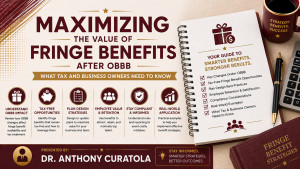
This two-hour course covers the fringe benefit landscape for 2026, with particular attention to what the One Big Beautiful Bill Act changed. It works through the statutory benefits under IRC §§ 79, 117(d), 119, 125, 127, and 129 and the incidental fringes under § 132 — no-additional-cost services, employee discounts, working condition fringes, de minimis fringes, and qualified transportation — along with the nondiscrimination and substantiation rules and the W-2 and 1099-NEC consequences when a benefit becomes taxable.
OBBB provisions are addressed throughout: permanent § 127 educational assistance, the restored bicycle commuting exclusion, the increased dependent care limit, the permanent paid family and medical leave credit, and expanded moving expense treatment. The course also flags the § 274(o) deduction change taking effect in 2026 for employer-provided meals. Case law and computational examples anchor the discussion.
EVENT OBJECTIVE
Upon completion of this course, participants will be able to:
- Compare the after-tax value of a salary increase to an equivalent nontaxable fringe benefit.
- Determine whether a no-additional-cost service or qualified employee discount meets the exclusion requirements, including the excess capacity test and the applicable discount ceilings.
- Apply the nondiscrimination rules to highly compensated employees, former employees, and independent contractors.
- Analyze whether an expense qualifies as a working condition fringe, including employer-provided vehicles and education, and distinguish job-related education from education qualifying an employee for a new trade or business.
- Recognize the OBBB changes to educational assistance, dependent care assistance, qualified transportation fringes, moving expenses, and the paid family and medical leave credit.
- Calculate the taxable inclusion for group-term life insurance coverage exceeding $50,000 using the Table I cost rates.
- Distinguish excludable de minimis fringes from cash, cash equivalents, and regularly provided benefits treated as wages.
- Determine the correct reporting treatment for taxable fringe benefits on Forms W-2, W-3, and 1099-NEC.
COURSE NAME
Maximizing the Value of Fringe Benefits After OBBB for 2026