EVENT DESCRIPTION
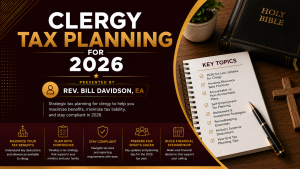
Ministers and clergy members face a unique set of tax rules that can create both valuable planning opportunities and significant compliance challenges. This course explores the specialized tax provisions available to clergy, including housing allowance exclusions, ministerial compensation, retirement planning strategies, and the tax treatment of gifts and other forms of church-provided benefits.
Participants will gain a practical understanding of how clergy taxation differs from traditional employee taxation and learn how to navigate common issues that arise when advising ministers and religious organizations. The course also examines key provisions of the One Big Beautiful Bill (OBBB) Act and discusses how recent legislative changes may impact clergy tax planning and reporting requirements.
Through real-world examples and practical applications, attendees will leave with actionable strategies to help clergy clients maximize available tax benefits, avoid common pitfalls, and remain compliant with IRS regulations.
EVENT OBJECTIVE
Upon completion of this course, participants will be able to:
- Identify the unique tax rules and reporting requirements applicable to clergy and ministers.
- Explain the tax advantages and limitations of the clergy housing allowance exclusion.
- Evaluate retirement planning opportunities and tax-saving strategies available to active and retired clergy.
- Recognize the tax implications of ministerial compensation, love offerings, gifts, and other church-provided benefits.
- Apply IRS guidance and best practices to minimize compliance risks and avoid common clergy tax errors.
- Analyze the impact of recent OBBB Act provisions on clergy taxation and financial planning.
- Advise clergy clients on strategies to maximize tax benefits while maintaining compliance with federal tax law.
COURSE NAME
Clergy Tax Planning for 2026